What Is a VantageScore? FICO vs VantageScore (2026)
Table of Contents
- What Is a VantageScore?
- Quick Answer
- Why Was VantageScore Created?
- Who Created VantageScore?
- Is VantageScore a Real Credit Score?
- How Does VantageScore Work?
- VantageScore vs FICO® Score
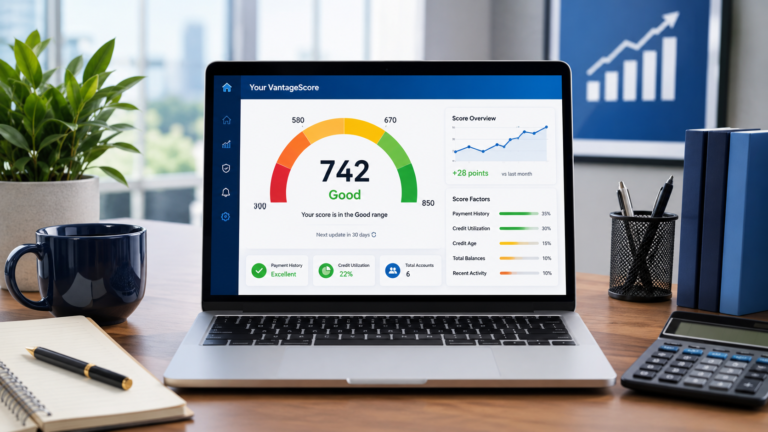
- What Factors Affect Your VantageScore?
- VantageScore Credit Score Ranges
- Which Lenders Use VantageScore?
- Can You Improve Your VantageScore?
- Common VantageScore Myths
- Frequently Asked Questions (FAQs)
- Final Verdict
- Conclusion
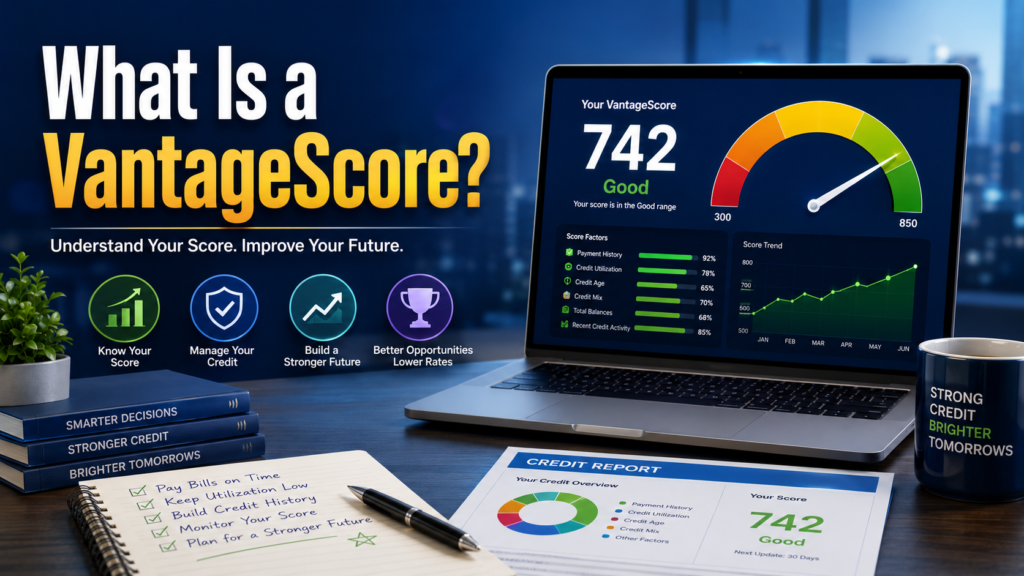
What Is a VantageScore?
If you’ve ever checked your credit through Credit Karma, Capital One, Chase, or another financial app, you’ve probably seen something called a VantageScore.
But What Is a VantageScore, and why is it different from your FICO® Score?
Many Americans assume that all credit scores are the same. In reality, different credit scoring models exist, and lenders may use different systems depending on the type of loan you’re applying for.
Understanding What Is a VantageScore can help you:
- Understand why your credit scores sometimes differ.
- Track your credit more accurately.
- Prepare for mortgage or credit card applications.
- Make smarter financial decisions.
- Improve your overall credit profile.
Whether you’re applying for a mortgage, auto loan, personal loan, or credit card, knowing how VantageScore works is an important part of managing your financial future.
Quick Answer
What Is a VantageScore?
A VantageScore is a credit scoring model developed jointly by the three major credit bureaus:
- Experian
- Equifax
- TransUnion
It analyzes the information in your credit report and generates a three-digit credit score that helps lenders evaluate your creditworthiness.
Like a FICO® Score, a VantageScore generally ranges from 300 to 850, with higher scores indicating lower lending risk.
Today, millions of consumers use VantageScore through free credit monitoring services, making it one of the most widely viewed credit scores in the United States.
Why Was VantageScore Created?
For many years, FICO® dominated the credit scoring industry.
However, the three major credit bureaus wanted an alternative scoring model that could:
- Score more consumers with limited credit histories.
- Use newer credit data more efficiently.
- Improve scoring consistency across bureaus.
- Increase competition within the credit scoring industry.
As a result, VantageScore Solutions LLC introduced the first VantageScore model in 2006.
Since then, several updated versions have been released, including the latest VantageScore 4.0, which uses modern scoring techniques and updated consumer behavior analysis.
Who Created VantageScore?
Unlike FICO®, which is produced by the Fair Isaac Corporation, VantageScore was created jointly by:
Because it is supported by all three national credit bureaus, consumers often receive a VantageScore when checking their credit through banks, financial institutions, and free credit monitoring websites.
Is VantageScore a Real Credit Score?
Yes.
One of the biggest misconceptions online is that VantageScore isn’t a “real” credit score.
That’s false.
A VantageScore is a legitimate credit score used by many lenders across the United States.
However, not every lender uses the same scoring model.
Some lenders rely primarily on:
Others may use:
Some financial institutions even review both scores before making lending decisions.
That’s why it’s helpful to understand both scoring systems.
Related Guide: How Is a Credit Score Calculated in USA?
How Does VantageScore Work?
Understanding What Is a VantageScore becomes much easier when you know how this credit scoring model evaluates your financial behavior.
Unlike older credit scoring systems, VantageScore was designed to score more consumers, including people with relatively short credit histories.
Instead of looking at just one financial habit, VantageScore analyzes multiple pieces of information from your credit report to calculate your overall VantageScore credit score.
These factors work together to predict how likely you are to repay borrowed money responsibly.
What Information Does VantageScore Use?
A VantageScore is calculated using information reported by the three major credit bureaus:
- Experian
- Equifax
- TransUnion
The scoring model evaluates:
- Payment history
- Credit utilization
- Age of accounts
- Total debt
- Credit mix
- Recent credit inquiries
- Available credit
- Revolving balances
Unlike many people believe, your:
 Income
Bank account balance
Salary
Employment status
Age
are NOT directly included in your VantageScore calculation.
Main Factors That Affect Your VantageScore
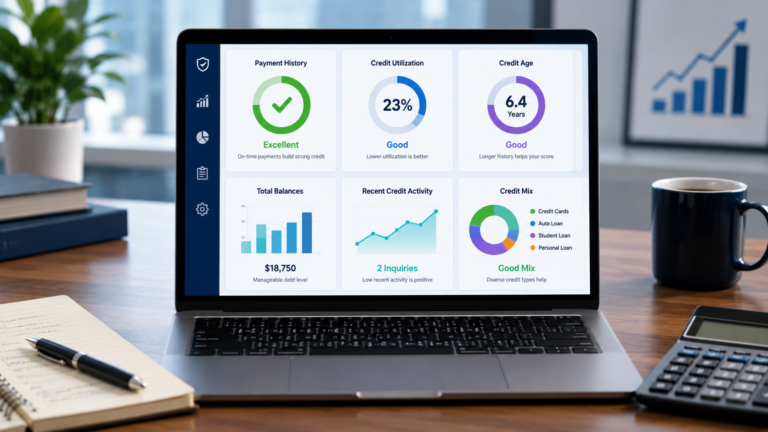
Although the exact formula is proprietary, these are the most important factors influencing your VantageScore credit score.
1. Payment History
Payment history remains the single most important part of nearly every credit scoring model.
Paying bills on time consistently demonstrates responsible financial behavior.
Late payments, collections, charge-offs, and defaults can significantly reduce your score.
The easiest way to improve your credit score is simply paying every bill before the due date.
2. Credit Utilization
Credit utilization measures how much of your available credit you’re currently using.
Example:
Credit Card Limit:
$10,000
Current Balance:
$2,000
Credit Utilization:
20%
Experts generally recommend keeping utilization below 30%, while below 10% is considered even better.
High utilization signals increased borrowing risk.
3. Credit Age
The longer your credit history, the better.
VantageScore rewards consumers who have maintained accounts responsibly for many years.
Closing your oldest credit card may reduce your average credit age over time.
4. Total Balances
VantageScore also looks at your overall debt.
Someone carrying large balances across several credit cards may appear riskier than someone using credit responsibly.
5. Recent Credit Activity
Every time you apply for new credit, lenders may perform a hard inquiry.
Several hard inquiries within a short period may temporarily reduce your score.
However, checking your own credit score creates only a soft inquiry, which does not affect your credit score.
Related Guide: Does Checking Your Credit Score Lower It? (Internal Link to Article #15)
6. Credit Mix
Having different types of credit may positively influence your VantageScore.
Examples include:
- Credit cards
- Auto loans
- Student loans
- Personal loans
- Mortgages
A healthy mix shows lenders that you can manage different forms of borrowing responsibly.
How Is VantageScore Different from FICO?
Many people ask:
FICO vs VantageScore — what’s the difference?
Although both models predict lending risk, they calculate scores differently.
| Feature | VantageScore | FICO Score |
|---|
| Developed By | Experian, Equifax & TransUnion | Fair Isaac Corporation |
| Score Range | 300–850 | 300–850 |
| Uses Alternative Data | More frequently | Limited |
| Scores Short Credit Histories | Yes | Sometimes not |
| Latest Version | VantageScore 4.0 | FICO 10T |
Neither model is “better.”
The score your lender uses depends on the institution and loan type.
Many mortgage lenders still rely primarily on FICO®, while banks, credit card issuers, and free monitoring services increasingly provide VantageScore.
Does VantageScore Change Every Day?
Yes.
Your VantageScore can change whenever new information appears on your credit report.
Common reasons include:
- Paying down credit card balances
- New account opening
- Late payment reporting
- Credit utilization changes
- Credit limit increases
- Hard inquiries
Monitoring your score regularly helps you identify changes before applying for major financing.
VantageScore Credit Score Ranges Explained
Now that you understand What Is a VantageScore, the next question is:
What is considered a good VantageScore?
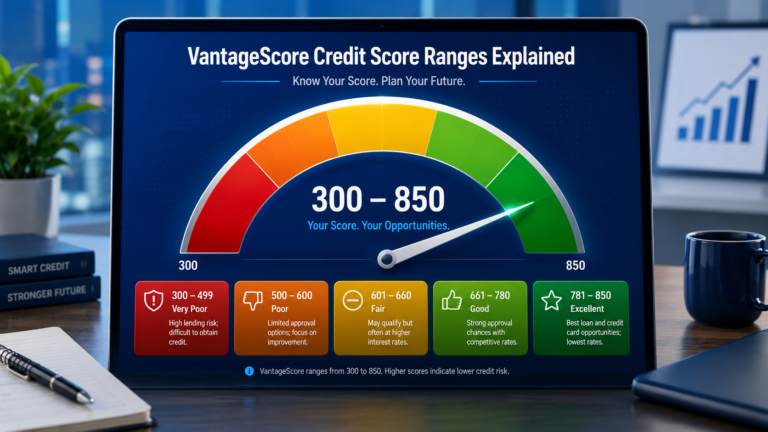
Like the FICO® Score, the VantageScore ranges from 300 to 850. The higher your score, the lower the lending risk you generally present to banks and financial institutions.
Here’s how VantageScore credit score ranges are commonly interpreted.
| VantageScore Range | Rating | What It Means |
|---|
| 781–850 | Excellent | Best loan and credit card opportunities |
| 661–780 | Good | Strong approval chances with competitive rates |
| 601–660 | Fair | May qualify but often at higher interest rates |
| 500–600 | Poor | Limited approval options |
| 300–499 | Very Poor | High lending risk; difficult to obtain new credit |
While these ranges provide a useful guideline, each lender may have its own approval requirements.
What Is a Good VantageScore?
Many consumers searching “What Is a VantageScore” are actually trying to determine whether their current score is considered good enough.
Generally speaking:
Excellent (781–850)
Consumers in this range usually qualify for:
- Lowest mortgage rates
- Premium credit cards
- Larger credit limits
- Better auto loan financing
Good (661–780)
A good VantageScore allows most consumers to:
- Receive credit card approvals
- Obtain personal loans
- Finance vehicles
- Apply for mortgages with competitive rates
Fair (601–660)
Borrowers in this category may still receive approval, but lenders often charge:
- Higher interest rates
- Lower credit limits
- Additional lending requirements
Poor (500–600)
At this stage, improving your payment history and reducing credit utilization becomes essential.
Many lenders may decline applications until your score improves.
Very Poor (300–499)
Consumers in this range usually need to focus on rebuilding credit before applying for major financing.
Fortunately, even low scores can improve over time with consistent financial habits.
Related Guide: How to Improve Credit Score in USA
Which Lenders Use VantageScore?
A common question after learning What Is a VantageScore is whether banks actually use it.
The answer is:
Yes — many do.
Today, thousands of financial institutions use VantageScore during different parts of the lending process.
Examples include:
- Credit card issuers
- Auto finance companies
- Personal loan providers
- Online lenders
- Credit monitoring platforms
However, many mortgage lenders continue using specific versions of the FICO® Score when making home loan decisions.
That’s why it’s helpful to monitor both scoring models whenever possible.
Can Your VantageScore Be Different from Your FICO Score?
Absolutely.
Many consumers notice that their VantageScore differs from their FICO Score.
This happens because:
- Different scoring formulas are used.
- Certain factors receive different weight.
- Some lenders use updated scoring models.
- Credit report information may update at different times.
A difference of 10–30 points between the two scores is completely normal.
The important thing is maintaining healthy credit habits rather than worrying about small score differences.
How Often Should You Check Your VantageScore?
Financial experts recommend checking your VantageScore at least once every month.
Regular monitoring helps you:
- Detect identity theft
- Find reporting errors
- Track your progress
- Understand how financial decisions affect your score
Checking your own credit score is a soft inquiry, meaning it does not lower your credit score.
This is one reason why free credit monitoring services have become increasingly popular.
Common Mistakes That Lower Your VantageScore
Even consumers who understand What Is a VantageScore sometimes unknowingly damage their scores.
Avoid these common mistakes:
Missing payment deadlines
Late payments remain one of the biggest reasons for lower credit scores.
Using too much available credit
Keeping credit utilization below 30% is recommended, while below 10% is even better.
Applying for multiple credit cards at once
Too many hard inquiries within a short period may reduce your score temporarily.
Closing your oldest credit card
Older accounts help build a longer credit history.
Ignoring your credit report
Mistakes on your credit report can sometimes reduce your score unfairly.
Monitoring your report regularly allows you to dispute errors quickly.
Frequently Asked Questions (FAQs)



 Want to build a stronger credit profile? Explore our complete collection of credit score guides on BF Credit Score and start making informed financial decisions today.
Pingback: Best Credit Report Apps in USA (2026) – Top 10 Compared - Credify UP
Pingback: Best Free Credit Monitoring Services in USA (2026) - Credify UP
“Thank you aapke comment ke liye! Agar aap credit score aur monitoring ke baare mein aur jaanna chahte hain, toh aap hamare ye articles check kar sakte hain:
Best Credit Score Apps in USA: https://bfcreditscore.com/best-credit-score-apps-usa/
Best Credit Monitoring Services in USA: https://bfcreditscore.com/best-credit-monitoring-services-in-usa/
Pingback: What Is a VantageScore? Complete Guide (2026) - Credify UP
“Thank you aapke comment ke liye! Agar aap credit score aur monitoring ke baare mein aur jaanna chahte hain, toh aap hamare ye articles check kar sakte hain:
Best Credit Score Apps in USA: https://bfcreditscore.com/best-credit-score-apps-usa/
Best Credit Monitoring Services in USA: https://bfcreditscore.com/best-credit-monitoring-services-in-usa/