What Is a VantageScore? Complete Guide (2026)
Table of Contents
- What Is a VantageScore?
- Who Created VantageScore?
- Why Was VantageScore Developed?
- How Does VantageScore Work?
- VantageScore Ranges Explained
- VantageScore vs FICO Score
- Factors That Affect Your VantageScore
- How to Improve Your VantageScore
- Frequently Asked Questions
- Final Verdict
What Is a VantageScore? Complete Guide (2026)
Your credit score plays a major role in your financial life. Whether you’re applying for a credit card, buying a home, financing a car, or qualifying for a personal loan, lenders often review your credit score before making a decision.
Many people are familiar with the FICO® Score, but fewer understand What Is a VantageScore and why it matters. Today, millions of lenders, banks, credit card companies, and financial institutions also use VantageScore to evaluate borrowers.
So, What Is a VantageScore?
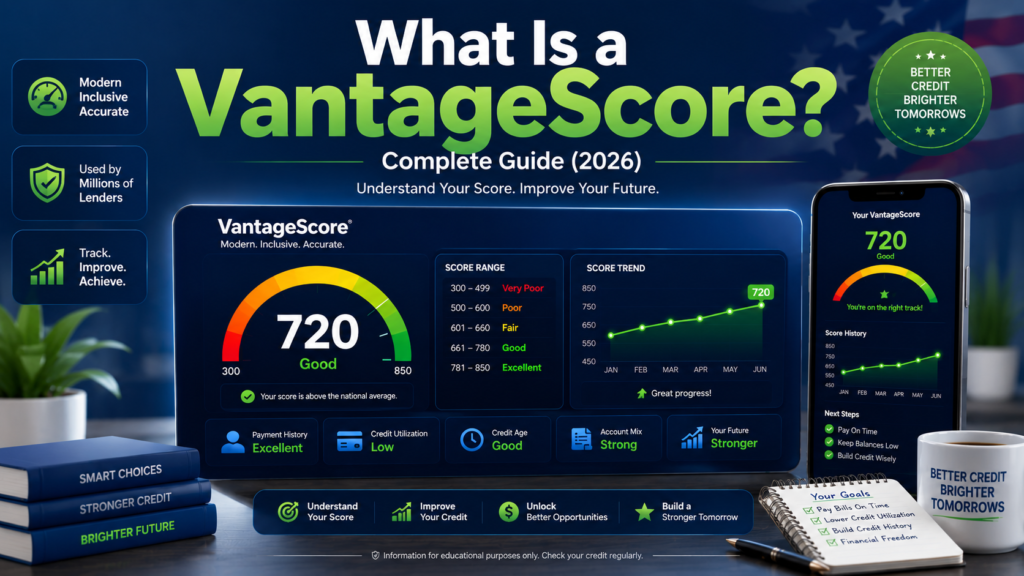
A VantageScore is a credit scoring model developed jointly by the three major U.S. credit bureaus—Experian, Equifax, and TransUnion. It analyzes the information contained in your credit report and converts it into a three-digit number that represents your creditworthiness.
Just like other credit score models, a higher VantageScore generally indicates lower lending risk, while a lower score may make it harder to qualify for loans or obtain favorable interest rates.
Unlike older scoring models, VantageScore was designed to provide more consumers with a credit score, including people with limited credit histories. This makes it an important tool for first-time borrowers and individuals working to establish or rebuild their credit.
If you’ve ever wondered What Is a VantageScore and how it compares with a FICO Score, this guide explains everything you need to know.
By the end of this article, you’ll understand:
- What a VantageScore is
- How it works
- How it’s calculated
- The different VantageScore ranges
- How lenders use it
- How to improve your score over time
Whether you’re trying to improve your credit score, monitor your financial health, or prepare for a major purchase, understanding What Is a VantageScore is an essential step toward making smarter financial decisions.
Who Created VantageScore?
The VantageScore model was introduced in 2006 by the three nationwide credit bureaus:
These companies collaborated to create an alternative credit scoring model that could compete with the long-established FICO® Score while making credit scoring more consistent across all three bureaus.
Since its launch, VantageScore has evolved through several versions, including:
- VantageScore 1.0
- VantageScore 2.0
- VantageScore 3.0
- VantageScore 4.0
Today, VantageScore 4.0 is considered the latest and most advanced version, using machine learning and updated credit behavior analysis to predict lending risk more accurately.
As more financial institutions adopt modern scoring systems, understanding What Is a VantageScore becomes increasingly important for consumers across the United States.
How Does VantageScore Work?
Understanding What Is a VantageScore also means understanding how this credit scoring model evaluates your financial behavior.
Unlike many people believe, your VantageScore isn’t generated randomly. It is calculated using information reported by lenders to the three major credit bureaus:
- Experian
- Equifax
- TransUnion
Every time you use a credit card, make a payment, apply for a loan, or miss a payment, your credit profile changes. The VantageScore model analyzes this information to estimate how likely you are to repay future debts.
The better your financial habits, the higher your VantageScore will usually be.
How Is a VantageScore Calculated?
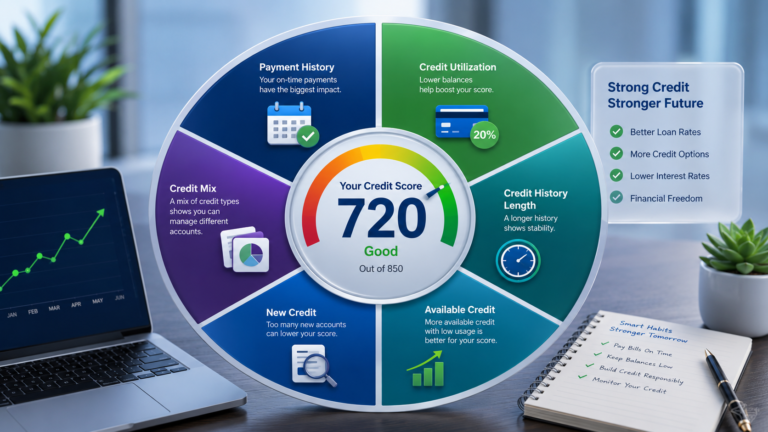
Although VantageScore doesn’t publicly reveal its exact formula, it evaluates several important credit factors.
These include:
 Payment History
Payment history is one of the most important parts of your VantageScore.
Making payments on time consistently shows lenders you’re a responsible borrower.
Late payments, missed payments, collections, and defaults can significantly lower your score.
Credit Utilization
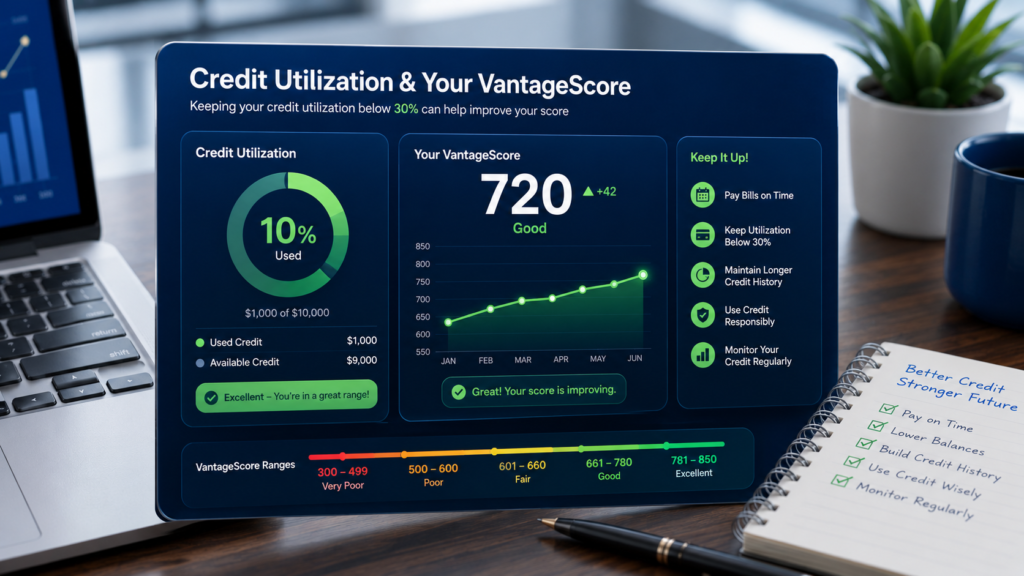
Credit utilization measures how much of your available credit you’re currently using.
Example:
Credit Card Limit:
$10,000
Current Balance:
$2,000
Credit Utilization:
20%
Experts generally recommend keeping utilization below 30%, while staying under 10% often produces even better results.
Lower utilization can help improve both your VantageScore and your FICO Score.
Length of Credit History
The longer you’ve managed credit responsibly, the better.
Older accounts help demonstrate financial stability.
Closing your oldest credit card may reduce your average account age.
Credit Mix
VantageScore likes to see different types of credit.
Examples include:
- Credit Cards
- Auto Loans
- Student Loans
- Mortgages
- Personal Loans
A healthy credit mix indicates that you can successfully manage different financial products.
New Credit
Every time you apply for new credit, a lender may perform a hard inquiry.
Too many hard inquiries within a short period can temporarily reduce your VantageScore.
Total Credit Available
Having more available credit while maintaining low balances generally benefits your score.
Responsible borrowing demonstrates lower financial risk.
VantageScore Ranges Explained
The most recent VantageScore models use a range from:
300–850
This is the same overall scale used by most modern FICO® Scores.
| Score Range |
Rating |
| 300–499 |
Very Poor |
| 500–600 |
Poor |
| 601–660 |
Fair |
| 661–780 |
Good |
| 781–850 |
Excellent |
If you’re asking What Is a VantageScore, understanding these ranges helps you evaluate your current financial position.
Generally:
- Above 700 is considered good.
- Above 780 is excellent.
- Above 800 is exceptional.
VantageScore vs FICO Score
One of the biggest questions consumers ask is:
VantageScore vs FICO — which is better?
The answer is:
Both are reliable credit scoring models.
However, they use slightly different methodologies.
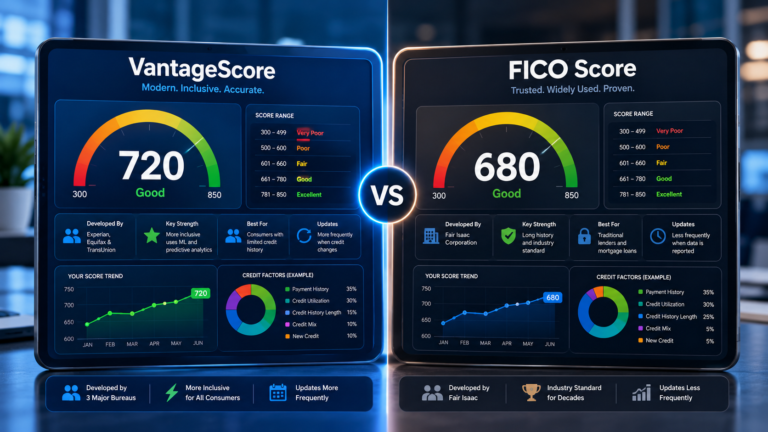
| Feature | VantageScore | FICO Score |
|---|
| Developed By | Experian, Equifax & TransUnion | Fair Isaac Corporation |
| Score Range | 300–850 | 300–850 |
| Minimum Credit History | Usually shorter | Usually longer |
| Uses Machine Learning | Yes (VantageScore 4.0) | Limited |
| Widely Used By Lenders | Yes | Yes |
Many lenders now check both scores depending on their internal policies.
That’s why understanding What Is a VantageScore is just as important as knowing your FICO Score.
Which Score Do Most Lenders Use?
Historically:
FICO dominated the lending industry.
Today:
Millions of lending decisions also rely on VantageScore.
Many:
- Banks
- Credit Card Companies
- Auto Lenders
- Personal Loan Providers
use VantageScore to evaluate borrowers.
Some lenders even review both scoring models before making a final lending decision.
Does VantageScore Update Frequently?
Yes.
Your VantageScore may change whenever your credit report receives new information.
Examples include:
- Paying down credit card balances.
- Missing payments.
- Opening new accounts.
- Closing credit cards.
- Hard inquiries.
- Credit utilization changes.
Using one of the Best Free Credit Monitoring Services in USA helps you track these updates automatically.
What Affects Your VantageScore?
Now that you understand What Is a VantageScore and how it is calculated, the next step is learning which financial behaviors have the biggest impact on your score.
Every action you take with your credit cards and loans influences your VantageScore. Good habits can gradually increase your score, while poor financial decisions may lower it.
Below are the most important factors that affect your VantageScore.
1. Payment History (Most Important Factor)
Your payment history is one of the strongest indicators of your creditworthiness.
Lenders want proof that you consistently repay borrowed money on time.
Positive payment history includes:
- Paying credit cards before the due date
- Paying loan installments on time
- Making at least the minimum payment every month
Negative payment history includes:
- Late payments
- Missed payments
- Collection accounts
- Loan defaults
- Bankruptcy
Even one missed payment can lower your VantageScore, especially if your credit history was previously excellent.
Tip
Set up automatic payments or payment reminders to avoid missing due dates.
2. Credit Utilization Ratio
One of the fastest ways to improve your VantageScore is by lowering your credit utilization ratio.
Credit utilization measures:
Current Balance ÷ Total Credit Limit × 100
Example:
Credit Limit:
$8,000
Balance:
$1,600
Utilization:
20%
Most financial experts recommend keeping utilization:
- Below 30%
- Ideally below 10%
Lower utilization signals responsible credit management and can positively affect both VantageScore and FICO Score.
3. Age of Credit Accounts
The longer your credit history, the better.
Older accounts demonstrate long-term financial responsibility.
For this reason:
Avoid closing your oldest credit card unless absolutely necessary.
Keeping mature accounts open can help strengthen your overall credit history.
4. Total Available Credit
Consumers often think having more credit cards hurts their score.
In reality:
Having higher available credit can actually help—as long as you don’t overspend.
For example:
Person A
Credit Limit:
$2,000
Balance:
$1,000
Utilization:
50%
Person B
Credit Limit:
$20,000
Balance:
$1,000
Utilization:
5%
Person B will generally have a stronger VantageScore because of the lower utilization percentage.
5. Credit Mix
VantageScore rewards borrowers who successfully manage different types of credit.
Examples include:
- Credit Cards
- Auto Loans
- Personal Loans
- Student Loans
- Mortgage Loans
A healthy mix demonstrates financial experience.
However, never open unnecessary accounts simply to improve your credit mix.
6. Recent Credit Activity
Every new credit application may trigger a hard inquiry.
Multiple hard inquiries within a short period can temporarily reduce your VantageScore.
Hard inquiries usually occur when applying for:
- Credit Cards
- Auto Loans
- Personal Loans
- Mortgages
Soft inquiries—such as checking your own credit score—do not affect your score.
7. Information on Your Credit Report
Your credit report contains the information used to calculate your VantageScore.
Always review your credit report regularly for:
- Incorrect balances
- Accounts that don’t belong to you
- Duplicate accounts
- Incorrect payment history
- Identity theft
Even small reporting errors can reduce your credit score.
Using one of the Best Free Credit Monitoring Services in USA makes it much easier to detect these problems quickly.
How to Improve Your VantageScore
If your score is lower than expected, don’t worry.
Improving your VantageScore takes time, but consistent habits produce excellent long-term results.
Here are some proven strategies:
Always Pay Bills On Time
Payment history remains one of the biggest scoring factors.
Reduce Credit Card Balances
Lower balances reduce your credit utilization ratio.
Avoid Unnecessary Hard Inquiries
Only apply for new credit when you genuinely need it.
Keep Older Accounts Open
Long credit history generally helps your score.
Monitor Your Credit Report
Review your reports frequently for errors and suspicious activity.
Use Credit Responsibly
Responsible borrowing over time leads to stronger credit scores.
If you want detailed step-by-step guidance, read our complete guide:
 How to Improve Credit Score in USA: 12 Proven Tips That Really Work (2026)
Frequently Asked Questions (FAQs)
1. What Is a VantageScore?
A VantageScore is a credit scoring model created by Experian, Equifax, and TransUnion. It uses information from your credit report to generate a score between 300 and 850, helping lenders evaluate your creditworthiness.
If you’re wondering What Is a VantageScore, it’s simply another widely used method of measuring how responsibly you manage credit.
2. Is VantageScore the same as a FICO Score?
No.
Although both use a 300–850 scoring range, VantageScore and FICO Score use different scoring models.
Both consider factors like:
- Payment history
- Credit utilization
- Credit age
- Credit mix
- New credit inquiries
However, the weighting of these factors can differ, meaning your VantageScore and FICO Score may not always be identical.
3. What Is a Good VantageScore?
Generally:
| Score | Rating |
|---|
| 300–499 | Very Poor |
| 500–600 | Poor |
| 601–660 | Fair |
| 661–780 | Good |
| 781–850 | Excellent |
A VantageScore above 700 is generally considered good by many lenders.
4. Does Checking My VantageScore Lower It?
No.
Checking your own VantageScore creates only a soft inquiry.
Soft inquiries never affect your credit score.
Only hard inquiries, such as applying for a new credit card or loan, may temporarily lower your score.
5. How Often Does My VantageScore Update?
Your VantageScore updates whenever your credit report receives new information from lenders.
Updates may occur after:
- Making payments
- Paying off debt
- Opening new accounts
- Closing credit cards
- Reporting new balances
Monitoring your score regularly helps you stay informed about these changes.
6. Can I Improve My VantageScore Quickly?
Yes—but it depends on your financial situation.
Some of the fastest ways include:
- Paying down credit card balances
- Reducing credit utilization
- Making every payment on time
- Correcting credit report errors
- Avoiding unnecessary hard inquiries
While some improvements may appear within weeks, significant increases usually require several months of responsible credit management.
7. Which Lenders Use VantageScore?
Today, many organizations use VantageScore, including:
- Banks
- Credit card issuers
- Auto lenders
- Personal loan providers
- Online lending platforms
Some lenders use only VantageScore, while others compare both VantageScore and FICO Score before approving applications.
Final Verdict
Now that you understand What Is a VantageScore, it’s clear why this credit scoring model has become an important part of the U.S. financial system.
Your VantageScore reflects how responsibly you manage your credit and can influence:
- Credit card approvals
- Mortgage applications
- Auto loans
- Personal loans
- Interest rates
Although it’s different from a FICO Score, both scoring models reward the same healthy financial habits:
- Paying bills on time
- Keeping credit utilization low
- Maintaining older credit accounts
- Monitoring your credit report regularly
- Limiting unnecessary hard inquiries
Understanding What Is a VantageScore gives you greater control over your financial future and helps you make smarter borrowing decisions.
Conclusion
Whether you’re building credit for the first time or working to improve an existing score, learning What Is a VantageScore is an important step toward better financial health.
By practicing responsible credit habits and using trusted credit monitoring services, you can steadily strengthen your credit profile over time.
If you’re serious about improving your overall credit health, continue reading our expert guides on BF Credit Score, where we explain every aspect of credit scores in simple, practical language designed for consumers across the United States.


Pingback: Why Did My Credit Score Drop? 15 Reasons (2026 Guide) - Credify UP
“Thank you aapke comment ke liye! Agar aap credit score aur monitoring ke baare mein aur jaanna chahte hain, toh aap hamare ye articles check kar sakte hain:
Best Credit Score Apps in USA: https://bfcreditscore.com/best-credit-score-apps-usa/
Best Credit Monitoring Services in USA: https://bfcreditscore.com/best-credit-monitoring-services-in-usa/