
How Often Does Your Credit Score Update? (2026 Guide)
- August 2, 2026
- tawebdevelopers
- 12:23 pm
Table of Contents
- How Often Does Your Credit Score Update?
- Why Credit Scores Change
- How Credit Bureaus Receive New Information
- How Often FICO and VantageScore Update
- When Credit Card Payments Affect Your Score
- Why Your Score May Not Update Immediately
- How to Speed Up Positive Credit Score Changes
- Frequently Asked Questions
- Final Thoughts
How Often Does Your Credit Score Update?
If you’ve recently paid off a credit card, made a loan payment, or reduced your debt, you may be wondering, “How often does your credit score update?” It’s one of the most common questions among people who want to improve their credit and monitor their financial progress.
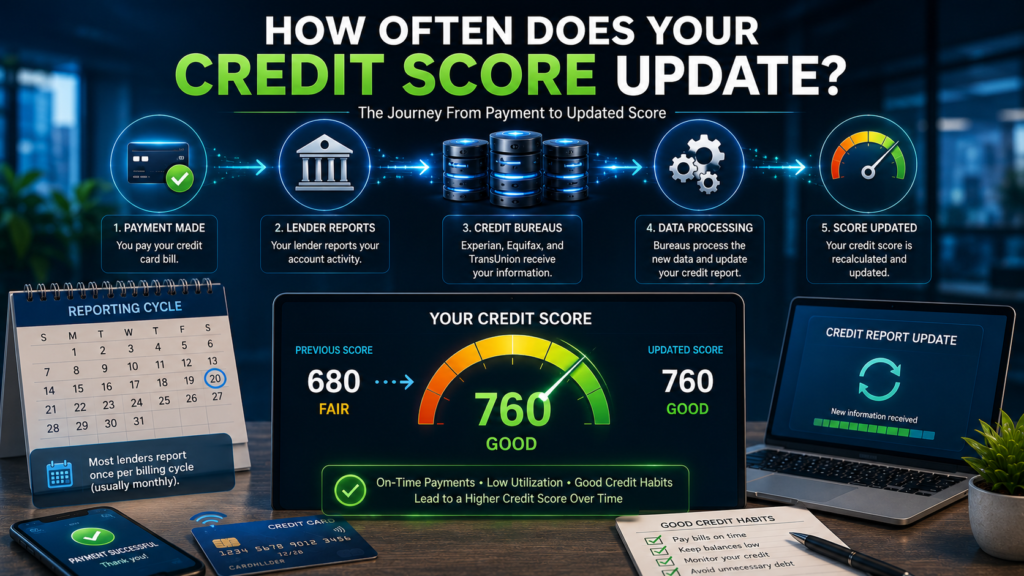
The answer is that your credit score doesn’t update on a fixed daily schedule. Instead, it changes whenever new information is reported to the major credit bureaus and your credit score is recalculated using the latest data.
Most lenders report account activity every month, but the exact timing varies depending on the lender and the credit bureau. As a result, your score may update several times in a month or remain unchanged until new information is received.
Understanding when and why your credit score updates can help you set realistic expectations, avoid unnecessary stress, and make smarter financial decisions.
In this guide, you’ll learn how credit score updates work, how often FICO® and VantageScore® may change, what factors influence updates, and what you can do to see positive improvements over time.
Update frequency can vary between providers, so compare the Best Credit Score Apps USA to understand the different score tracking and monitoring options available.

Why Credit Scores Change
Your credit score is designed to reflect your current credit behavior. Whenever new information is added to your credit report, your score may increase, decrease, or remain the same depending on the type of update.
Some of the most common reasons your credit score changes include:
- Making your monthly credit card payment.
- Paying off a loan balance.
- Increasing or decreasing your credit utilization.
- Opening a new credit account.
- Applying for new credit.
- Missing a payment.
- Closing an old credit card.
- Correcting errors on your credit report.
It’s important to remember that not every financial action causes an immediate change. Credit scores update only after lenders report new account information to the credit bureaus and the scoring model recalculates your score.
This is why two people with similar financial habits may see their scores update at different times.

How Credit Bureaus Receive New Information
Many people assume their credit score updates automatically every day. In reality, your credit score can only change after new information is reported to the major credit bureaus.
In the United States, there are three major credit bureaus:
These bureaus collect information from lenders, banks, credit card companies, auto loan providers, mortgage lenders, and other financial institutions.
Every month, most lenders send updated account information, including:
- Current account balance
- Payment status
- Credit limit
- Available credit
- Missed or late payments
- New accounts
- Closed accounts
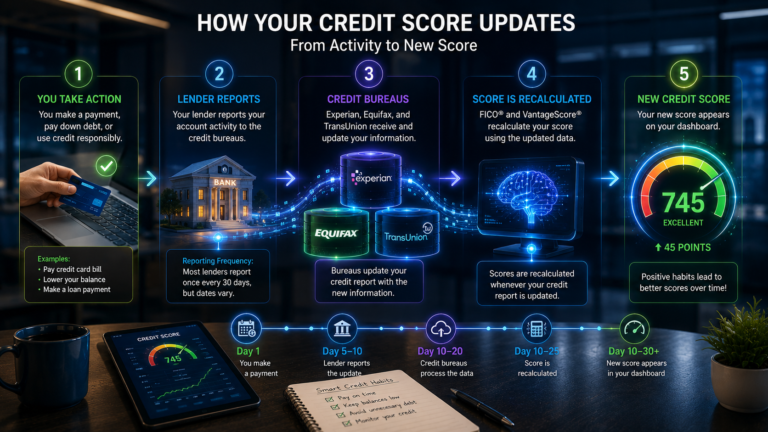
Once this information reaches the credit bureaus, your credit report is updated. Credit scoring models such as FICO® Score and VantageScore® then calculate your latest credit score using the updated data.
Because every lender follows its own reporting schedule, your accounts may update on different dates throughout the month. This is why your credit score may change several times in one month—or remain unchanged until new information is reported.

How Often Do FICO and VantageScore Update?
One of the biggest misconceptions is that FICO® and VantageScore® update on a fixed schedule every week or every month.
In reality, neither scoring model has a universal update date.
Instead, your score is recalculated whenever new information appears on your credit report.
For example:
- You pay your credit card balance.
- Your lender reports the payment.
- Your credit report is updated.
- Your FICO® or VantageScore® is recalculated.
This entire process may take anywhere from a few days to several weeks, depending on when your lender reports the new information.
Typical Reporting Frequency
| Financial Institution | Typical Reporting Frequency |
|---|---|
| Credit Card Companies | Every 30 days |
| Mortgage Lenders | Monthly |
| Auto Loan Providers | Monthly |
| Personal Loan Companies | Monthly |
| Student Loan Servicers | Monthly |
Keep in mind that reporting dates vary by lender. Some companies report on your statement closing date, while others report a few days later.
Because of these differences, your credit score does not always update immediately after making a payment.
When Will a Credit Card Payment Affect Your Credit Score?
One of the most common questions people ask is, “I paid my credit card today—when will my credit score update?”
The answer depends on when your credit card issuer reports your account activity to the credit bureaus.
Most credit card companies report your balance once every billing cycle, usually around your statement closing date rather than your payment date.
For example:
- July 5: You make a $500 payment.
- July 20: Your statement closes.
- July 22: The issuer reports the updated balance.
- A few days later: Your credit report updates.
- Shortly after: Your FICO® or VantageScore® may be recalculated.
This means your credit score may not increase immediately after making a payment, even if you’ve significantly reduced your balance.
Tips to See Faster Improvements
- Pay your balance before the statement closing date.
- Keep your credit utilization below 30% (ideally below 10%).
- Avoid making large purchases just before your statement closes.
- Continue making on-time payments every month.
Patience is important. Responsible habits usually produce better long-term results than trying to manipulate short-term score changes.

Why Your Credit Score May Not Update Immediately
Many people become concerned when they pay off debt but don’t see their credit score improve the next day.
In most cases, this is completely normal.
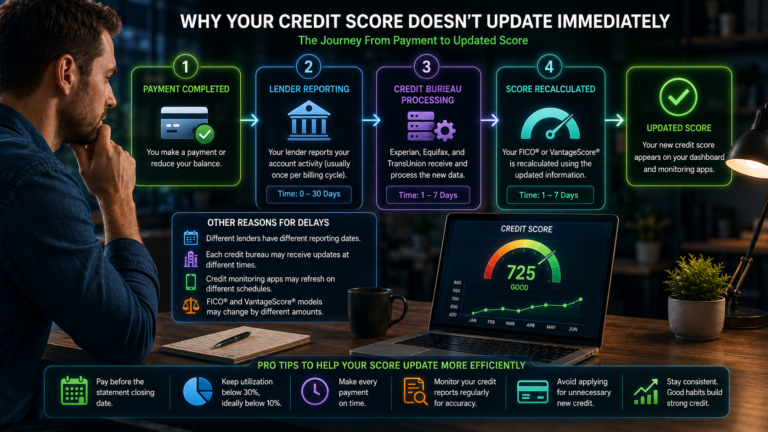
Several factors can delay a credit score update, including:
Your Lender Hasn’t Reported Yet
Most lenders report account activity once each month, not every day.
The Credit Bureau Is Still Processing New Data
Even after receiving updated information, the credit bureau may take a short time to process and add it to your credit report.
Different Bureaus Update at Different Times
Experian, Equifax, and TransUnion don’t always receive updates on the same day. As a result, you may notice different scores across different credit monitoring services.
Credit Monitoring Apps May Refresh Later
Some apps update daily, while others refresh weekly or monthly. Your monitoring app may simply be showing older information until its next refresh.
Scoring Models Can Differ
Your FICO® Score and VantageScore® may not always change by the same amount because each model evaluates your credit report slightly differently.
The key takeaway is simple:
A delay doesn’t necessarily mean your payment had no effect. It often just means the reporting and scoring process hasn’t finished yet.
Which Financial Activities Trigger a Credit Score Update?
Not every financial action changes your credit score immediately. However, several activities commonly trigger updates once lenders report them to the credit bureaus.
These include:
- Making a credit card payment.
- Paying off a loan.
- Opening a new credit card.
- Applying for a personal loan.
- Increasing your credit card balance.
- Missing a payment.
- Closing an old credit account.
- Becoming an authorized user on another person’s credit card.
Each of these actions may affect one or more credit score factors, including payment history, credit utilization, length of credit history, and new credit inquiries.
Remember that the update only happens after your lender reports the new information.
Pro Tips to Help Your Credit Score Update More Efficiently
 Pay your credit card balance before the statement closes.
Keep utilization under 30%, preferably below 10%.
Make every payment on time.
Monitor your credit reports regularly.
Avoid applying for unnecessary new credit.
Give lenders enough time to report updated information.
Following these habits consistently helps build stronger credit over time and reduces unnecessary frustration while waiting for score updates.
Does Every Lender Report to All Three Credit Bureaus?
One common misconception is that every lender reports account activity to all three major credit bureaus.
In reality, this isn’t always the case.
Some lenders report to:
- Experian only
- Equifax only
- TransUnion only
- Two bureaus
- All three bureaus
Because reporting practices differ, it’s possible for your credit reports—and even your credit scores—to vary slightly between bureaus.
This is completely normal and one reason why lenders may see slightly different scores depending on which bureau they check.
For this reason, it’s a good idea to review all three of your credit reports periodically instead of relying on just one.
Can Your Credit Score Update More Than Once Per Month?
Yes.
Although many lenders report account activity once every billing cycle, your credit score can update multiple times in the same month.
For example:
- One credit card issuer reports on the 5th.
- Your auto loan company reports on the 12th.
- Your mortgage lender reports on the 18th.
- Another credit card reports on the 27th.
Each time new information is added to your credit report, your credit score may be recalculated.
That’s why some credit monitoring services display several score changes throughout the month.
However, if no new information is reported, your score may remain unchanged until your next reporting cycle.
Frequently Asked Questions (FAQs)
Does your credit score update every day?
No. Your credit score does not automatically update every day. It changes whenever new information is reported to the credit bureaus and your credit report is refreshed. Some credit monitoring apps may display updates daily, but the underlying credit data only changes after lenders report new account activity.
How long after paying a credit card does your credit score update?
In most cases, your credit score updates within a few days to several weeks after your lender reports the new balance. The exact timing depends on your credit card issuer’s reporting schedule and the credit bureau’s processing time.
Why hasn’t my credit score changed after paying off debt?
There are several possible reasons:
- Your lender hasn’t reported the payment yet.
- The credit bureau is still processing new information.
- Your credit monitoring service hasn’t refreshed.
- Other factors on your credit report are offsetting the improvement.
Being patient and continuing healthy credit habits is usually the best approach.
Do all three credit bureaus update at the same time?
No. Experian, Equifax, and TransUnion receive information independently. Your lender may report to one bureau before another, which is why your credit scores can vary slightly between different credit monitoring services.
Can I speed up my credit score update?
You can’t force the credit bureaus to update your report instantly, but you can encourage faster positive changes by:
- Paying balances before your statement closing date.
- Keeping your credit utilization below 30%.
- Making every payment on time.
- Avoiding unnecessary hard inquiries.
- Monitoring your credit reports for errors.
Final Thoughts
Understanding how often your credit score updates helps you avoid unnecessary frustration and set realistic expectations.
Your score is not refreshed on a fixed schedule. Instead, it changes whenever lenders send updated account information to the credit bureaus, and the scoring models recalculate your credit profile.
The most effective way to improve your score isn’t checking it every day—it’s building consistent financial habits.
Pay your bills on time, keep your credit card balances low, avoid excessive borrowing, and review your credit reports regularly. Over time, these responsible actions can lead to a healthier credit score and better financial opportunities.
Remember, improving your credit is a marathon—not a sprint. Small, consistent actions today can make a significant difference in the future.
Key Takeaways
 Credit scores update after lenders report new information.
Most lenders report account activity once every billing cycle.
Credit card payments usually affect your score after the statement closing date.
Experian, Equifax, and TransUnion may update at different times.
Keeping utilization low and making on-time payments helps improve your score over time.